We support research conducted by junior and senior high school students on themselves, and help each individual take a step toward changing the world. We create a communicative and presentation environment where students can confidently pursue their research in their own way, and mentors with expertise will support their unprecedented, unique, and creative research ideas.
- TOP
- Science Castle Research Fund
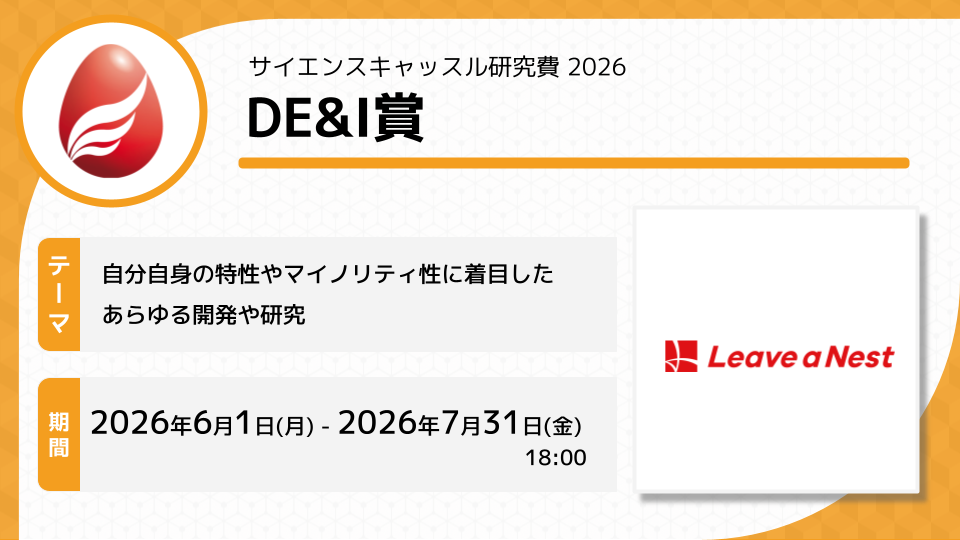
- Science Castle Research Fund 2026 DE&I Award
Science Castle Research Fund 2026 DE&I Award
The 2026 DE&I Award for Science Castle Research Grant has closed its application period.
Application Theme
Any development or research that focuses on one's own characteristics and minority identity
Summary
| Subject of application | Junior high school students, high school students, and technical college students (3rd year or younger) who are engaged in research activities Applicants with hearing or visual impairments are also eligible to apply. (Please consult with us if you have any concerns about other applicant characteristics.) |
|---|---|
| Examples of recruitment themes | I want to solve issues that I found because I am a minority. I have a hard time concentrating on conversations with friends in noisy places. I want to find a way to concentrate. Why is it that some days I don't want to go outside? Food availability is limited. We want to create a food environment where people can still enjoy themselves with their families and friends. I want to communicate my thoughts in ways other than speech. I want to find a way to communicate that suits me. I have trouble sleeping when I stay out overnight. I want to find a way to get back to sleep. |
| Usage | Expenses required for research and development (materials, purchase of parts, etc., equipment, transportation, etc., but excluding food and beverage expenses). (excluding food and beverage expenses) |
| Research Support Period | September 2026 - March 2027 |
| Thoughts of the person in charge | Click here to read the interview article. |
| briefing | For those who would like to know more details about the research content and target audience for this recruitment, or who have questions, please join our online information session. Details will be announced soon. Dates: Session 1: Wednesday, July 1, 2026, 5:00 PM - 6:00 PM / Session 2: Thursday, July 23, 2026, 4:00 PM - 5:00 PM Each session has similar content. Subject: Teachers, parents, etc. Contents: You will hear about research from researchers who have conducted studies on themselves, and we will introduce ways to proceed with research and support. Participation Fee: free Applications will be available soon. note (supplementary information) symbol Libanes ID Please log in to the "Application" page and click "Click here to apply". |
| Application Process | Application Process for more information, Application page here Please proceed with the description and application of your research from |
| Message | Are you feeling bewildered, middle and high school students? Perhaps, if you study those feelings thoroughly, it may lead to the first step to change your surroundings and society. If you have never done research before... don't worry, you will have a mentor with you. We look forward to hearing from you! |
| Support | We will consider how to follow up based on the applicant's characteristics, so please feel free to consult us with any concerns. I will support you from the creation of the application form. |
| Other | *In case of sensitive content, the student's name may not be open and a pseudonym may be used when posting on the web or making a presentation. |
Grant Details and Number of Grants Available
| Grant details ①. | 50,000 yen for research |
|---|---|
| Grant details (2) | Research mentoring by self-study experts |
| Grant details ③ | Results Presentation Meeting |
| Number of adoptions | Approx. 3 persons |
Application Requirements
- The junior high school student or high school or college of technology student who is applying must take the initiative in applying.
- Have the consent of the parent or guardian or the school to which the student belongs
- Be able to provide information (including contact information) to be included in the application
- Early September 2026The applicant must be able to participate in the kick-off event to be held on the day of the event (the date of the event will be decided upon consultation with the adopter). In addition, we will basically consider holding the event on site, but will make online participation available for those who live far away).
- Principle,December 2026A conference for middle and high school students to be held in "Science CastleYou will be able to participate in "World 2026" (participation will be in person in principle, but please contact us to discuss participation methods as needed).
- March 2027To be able to participate in the online results debriefing session to be held on
- In principle, you agree that information about the adopter and the content and results of the research (including personal information such as the adopter's name, age, affiliated school, and photograph) may be published in media operated by Leave a Nest Co., Ltd., including websites, publications, social media, and other media. (We will take measures to ensure that individuals cannot be identified depending on the research content.)
- I agree that the application information can be shared with the project management team (Leave a Nest Co., Ltd.).
Timeline
| Application period | Monday, June 1, 2026 – Friday, July 31, 2025, 6:00 PM |
|---|---|
| online briefing |
First Session: Wednesday, July 1, 2026, 5:00 PM - 6:00 PM / Second Session: Thursday, July 23, 2026, 4:00 PM - 5:00 PM https://id.lne.st/project/sc_grant_consultation/regist/basic_info/1 |
| Application Deadline | Friday, July 31, 2026 at 6:00 PM |
| Interview period | Early to mid-August 2026 (online interview) |
| Announcement of adoption | Early September 2026 |
| kickoff | Mid-September 2026 |
| Research grant | End of September 2026 |
| science castle |
December 12-13, 2026 (Saturday - Sunday) |
| presentation of results | March 2027 |
Application Process
Confirmation of Terms and Conditions and Application Guidelines
Please review the terms and conditions and the application guidelines on this page, and consult with us if you have any questions about the content.
Science Castle Research Grant DE&I Award 2026 Terms and Conditions
Register for a LIVERNESS ID
All middle and high school students who wish to apply are required to register all members of the team, whether they are representatives or not, with their RIBANES ID. The Research Grant Entry screen will appear after you log in to your RIBANES ID, so please register with your RIBANES ID.
Preparation of Consent Form
If this is part of a school activity, please prepare a consent form for school teachers (for schools); otherwise, please prepare a consent form for the person responsible for the protection of all team members (for individuals). Please download the model of the consent form below.
interpoint (interword separation) Science Castle Research Grant Agreement (for schools and individuals)
Please upload the scanned data of the completed and sealed documents from the application form, and send the original documents to the Science Castle Research Funding Office.
Mailing Address:
Livoo, Inc.
Human Resources Development Division
Tsuchiya
Iidabashi Miyuki Building 5F, 1-4 Shimomiyabicho, Shinjuku-ku, Tokyo 162-0822, Japan
Filling out and applying for research
Application page herePlease proceed with the description and application of your research from
In addition, please refer to the following points when writing the following two items when applying for this research grant.
(1) Application item: Why do you want to conduct the research or development (awareness of the representative's personal issues)?
<Points mentioned
Please be specific about how you arrived at the theme of this research, such as what experiences you had and how you felt.
Please also include any reasons why you decided to take on the challenge of research and development, rather than leaving issues and questions unanswered.
(2) Application Item: Anticipated Results and their Significance
<Points mentioned
In addition to the projected results of the research and development, please also describe what you would like the applicant to be like when the research and development is completed (a long-term perspective is fine, not limited to the period of support).
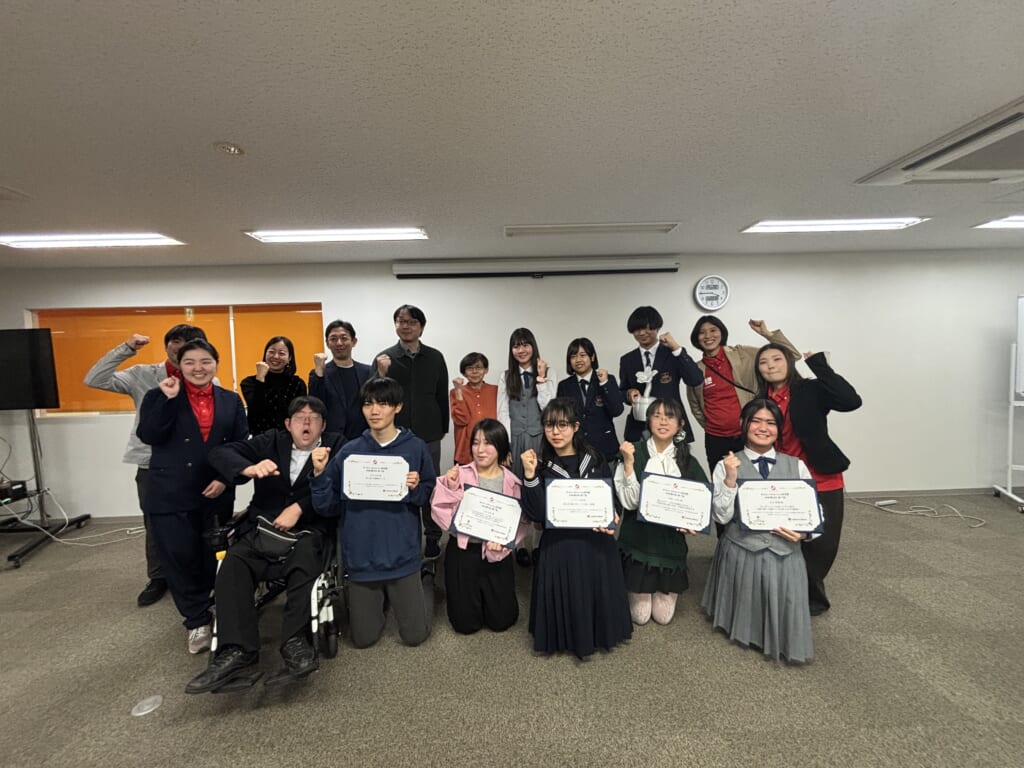
Last year's results presentation
It’s not just the outside world that’s on my mind.
When we think of research topics, we might imagine investigating things outside ourselves, such as natural phenomena or social issues. However, what troubles you personally, or things you feel are a little different from those around you, can also be the starting point for research. The Science Castle Research Grant DE&I Award was established in 2023 with the desire to support individuals in transforming such personal, urgent feelings of unease into research or development.
The discomfort I felt can become the starting point of research.
What might seem like a small discomfort to others can be a deeply felt, serious discrepancy for the individual. Observing these personal significant issues, articulating them, and turning them into questions that can be shared with others – that is the "self-research" that this program values. Even something you thought was a personal issue can, through research and sharing, lead to increased understanding from those around you, or become a help to someone else experiencing similar discomforts. In previous DE&I awards, themes born from students' own experiences and feelings have been researched, such as the reasons why they find it difficult to initiate conversations, the conditions under which they feel safe in classrooms or infirmaries, and their patterns of procrastination.
By trying small things, questions grow.
The starting point for self-research lies within oneself, not in those around you. It's okay if, at first, you can't quite put your feelings into words. Observe and record when and where that sense of discomfort arises and with whom. Listen to others, try out tools, and make small changes in your behavior. From these small steps, research and development themes will grow. After acceptance into the program, experts and LiveNess staff will act as research coaches, accompanying participants and helping them organize their questions and think about how to proceed. For example, a student who wanted to create a device to help a loved one with hearing difficulties initially struggled with the thought, "If similar products already exist, is there any point in me working on this?" Through mentoring, they began to focus on everyday inconveniences that existing devices couldn't fully address. They also realized they could start with small prototypes rather than aiming for a finished product, leading them to develop glasses that transmit information through vibrations. The program's great appeal lies in the opportunity to re-engage with issues you thought were beyond your control through research. In this process, you may discover what you can do and find your approach to challenges changes.
Meet peers who are also focusing on self-research.
Facing one's own questions is also a challenge, sometimes proceeding with the doubt of "Is this okay?" That's exactly why this program values encounters with peers who have started their research based on similar feelings of unease, and with adults who listen attentively to those questions. We've received feedback from past participants such as, "Having people who listen to my research, and who listen with a warm attitude, truly became a source of strength for me." These encounters are not about dismissing someone else's discomfort as "no big deal" or immediately imposing an answer. Rather, such encounters become the strength to continue facing one's own questions.
Even a vague sense of unease that you can't yet put into words can be the start of research if it feels urgent to you. I want you to look at the thoughts and feelings of unease within yourself, and try to shape them into research and development. (Text by Yuki Oshima)
Science Castle Research Funding Now Open for Applications
There are no Science Castle research funds available at this time.
 Home
Home science
 the current fiscal year
 academic conference