
- Featured
- Notice
First time abroad, first time presenting in English! High school students accept the challenge of receiving a "special offer from Dr. M.
2025.12.11
Two junior and senior high school student researchers were at Science Castle Asia 2025 to try their hand at presenting in English for the first time on their first trip abroad. They gave poster presentations at Science Castle Japan 2025 held at Kansai University in March this year and participated in the "Science Castle Japan 2025" held during the conference.Special offer from Dr. M - Global PassportI obtained overseas travel support at "Science Castle Asia". With the support of RIVANES, the students obtained passports, made arrangements for overseas travel, prepared poster materials and presentations in English, and finally arrived at the day of Science Castle Asia. After the conference, she said with a smile, "I think I can do well overseas. At RIVERNESS, we will continue to support these young Japanese researchers as they continue to explore their own questions on the world stage.
Expand your own research possibilities
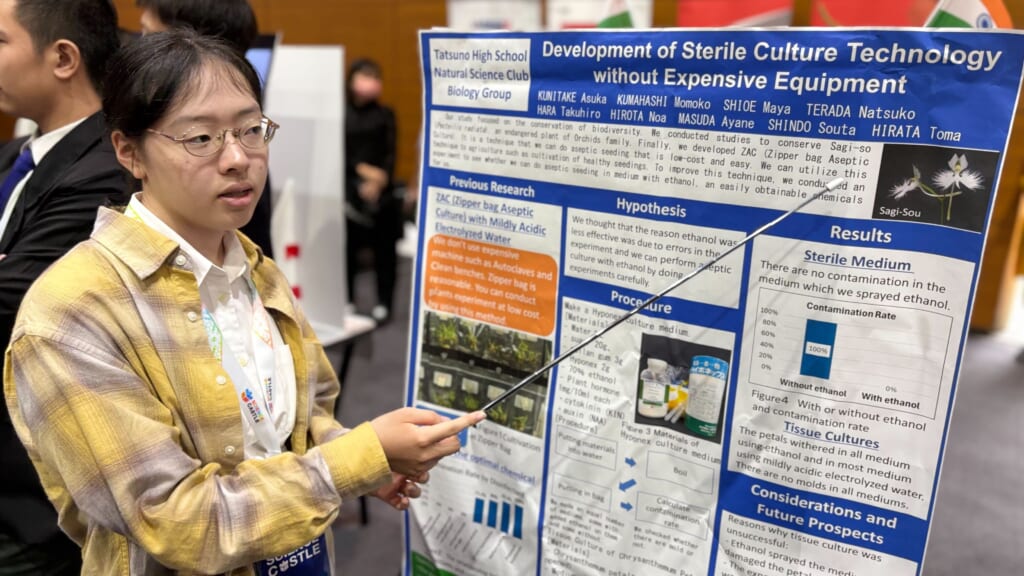
Asuka Kunitake, a student at Hyogo Prefectural Tatsuno High School, was working to develop a method for creating a sterile culture medium that even elementary school students can easily produce, with the aim of preserving the local orchid plant, Sagiso (Sagittaria). Using slightly acidic electrolyzed water with hypochlorous acid as the main ingredient, ethanol, and other disinfectants, she uses plastic bags with zippers to create a sterile medium for seed germination. The advice he received at Science Castle Japan that this method could be used in Southeast Asia led him to consider the possibility of expanding this method to the rest of the world, which led to this presentation.
I have found that my generation in Southeast Asia is much more interested in this product than I had expected," he says. I would like to spread ZAC (Zipper bag Aseptic Culture), which we developed this time, together with them," he said emphatically. Although he struggled to give his presentation in English, which he was not accustomed to, the possibilities of his research changed from hypothesis to conviction as he showed the actual culture medium he had created and used gestures to convey his ideas. This was truly a moment for a Japanese junior and senior high school student researcher to spread her wings to the world.
A new hypothesis to ask the world
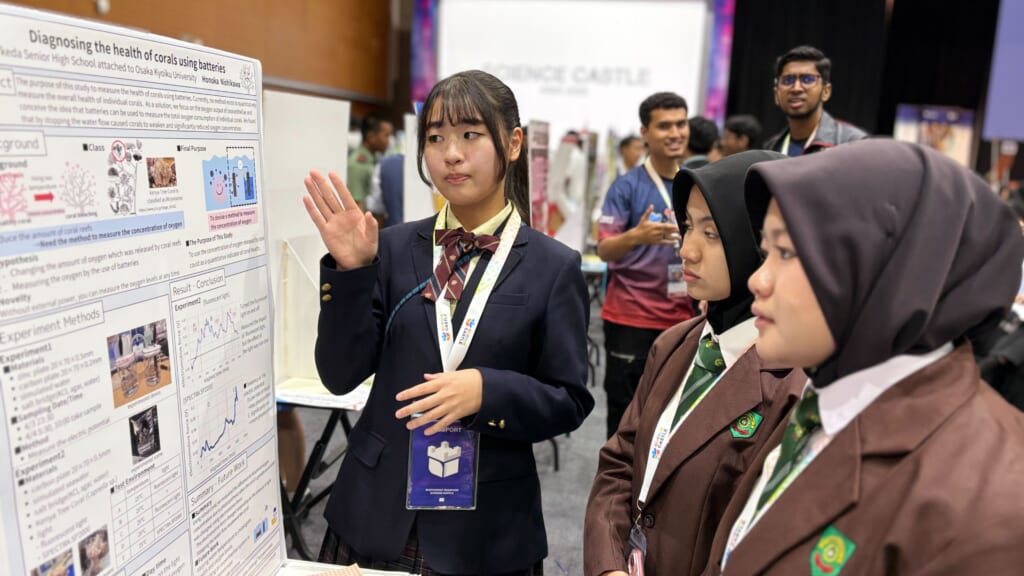
Ayuka Nishikawa of Ikeda High School attached to Osaka Kyoiku University is testing a simple method of measuring coral health using the principle of a battery. She is considering the possibility of detecting the amount of dissolved oxygen in seawater, which changes in accordance with the photosynthetic activity of zooxanthellae living symbiotically inside corals, as a change in electric potential. Mr. Nishikawa is eager to share this idea, which no one has yet tested, with junior and senior high school students in Southeast Asia, who are familiar with coral reefs in the sea.
On the day of the event, in addition to the poster presentation, a short pitch was given on stage to an audience of over 2,000 people. In the end, they won the Focus Systems Award and the INOCA Award. Nishikawa says, "I realized that there are many things I still need to think about, so I can't wait to get started on the next experiment. After discussions with fellow researchers in Southeast Asia, the next trial and error process is about to begin.
(Reprinted in part from Education Support vol. 68, p. 35)
This project is,Science Castle World 2025We are also planning to conduct the event in For more information on the 2026 season, please click here. We look forward to seeing you at one of our international competitions.
 Home
Home science
 the current fiscal year
 academic conference